
Teaching Mental Toughness and Personal Accountability
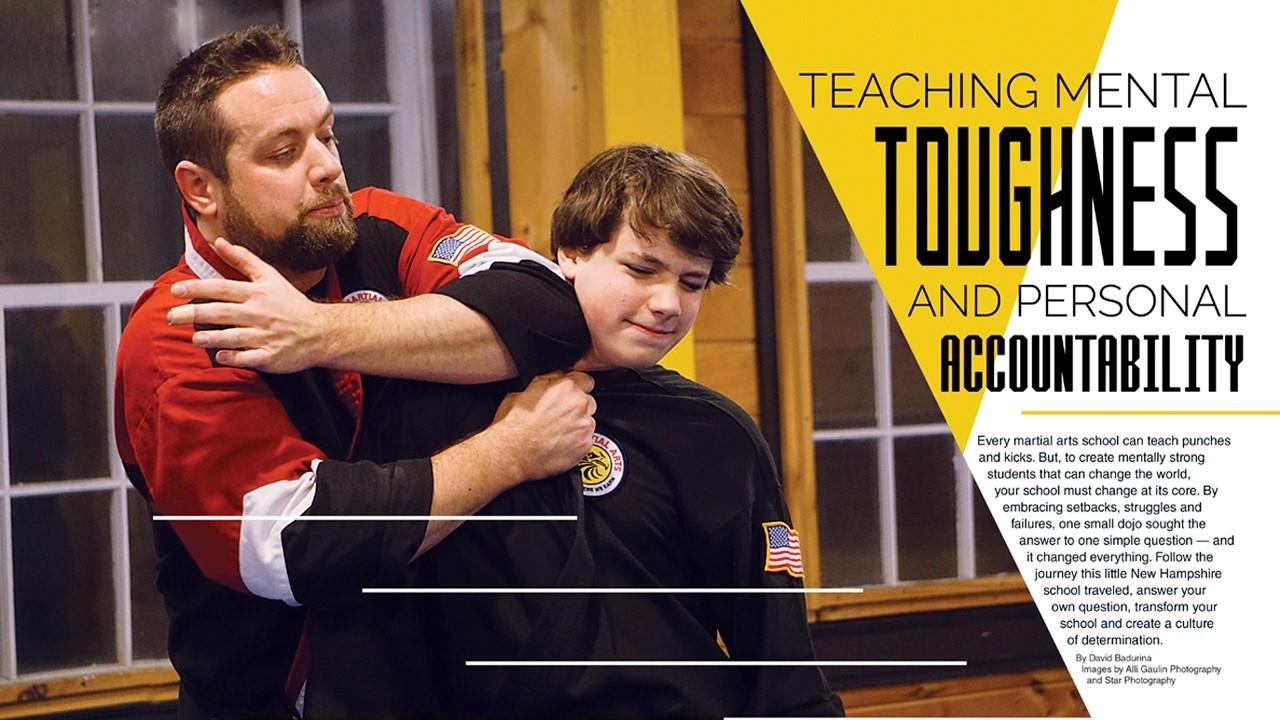
Every martial arts school can teach punches and kicks. But, to create mentally strong students that can change the world, your school must change at its core. By embracing setbacks, struggles and failures, one small dojo sought the answer to one simple question — and it changed everything. Follow the journey this little New Hampshire school traveled, answer your own question, transform your school and create a culture of determination.
By David Badurina
Everybody has a unique story filled with countless decisions, failures and successes. As a martial artist, a teacher or a business owner, you are very familiar with opportunity. Whether it’s the opportunity to own and run your own school, to find a bigger, better space or to do something you’ve always wanted to do.
Think about it. Your day is filled with countless opportunities, some tiny and some huge.
What about the opportunity to be a change-maker? I’m not talking about teaching some self-defense at a summer program, or, the opportunity to rake in some cash by throwing birthday parties at your dojo.
This is about creating a clearly defined purpose behind everything you do that shapes the culture of your school into something incredible and unique. And when that happens, you will have no competitors!
Our school, Liberty Martial Arts here in Littleton, New Hampshire, has about 70 students. Yet, it has been steadily changing our community to create positive ripples that will be extending
outward for a lifetime. It reaches far outside of our geographical sphere of influence.
For us, it came down to one simple question. A question that I’m going to ask you in just a moment. Be aware: Your answer may very well change everything about who you are and what you do.
When we answered this question, and let it guide our philosophy, it became clear that we were not “just another dojo.” It made us a place with no competition, place with incredibly supportive students and parents, and more importantly, a place where people feel like it’s an integral part of their life to be a part of our school!
Our Demographics
First, I’m going to tell you a little bit about our small dojo in Littleton. We’re in a town of 6,000 people, surrounded by mountains and rivers. We run two beginner-kid’s classes, one intermediate/advanced kid’s class, and an all-rank adult class. Occasionally, we throw out a kickboxing class to blow off some steam and get in some fun workouts.
Like any dojo, we have belt tests, attend a few local tournaments, and have an end-of-year party with some fun awards and a potluck dinner. We have three primary staff members, a few assistant instructors and occasional help from younger students. All of this keeps the engine going and the rent paid.
Like any story worth telling, the story of our dojo didn’t start with a lucky break and skyrocketing success. It started with an epic-drama hurricane that trashed my belief that anything I was doing was worthwhile. It drained me emotionally, physically and mentally for weeks on end. It destroyed personal relationships and my faith that there was anything except for drama and politics when you went beyond training on the mats.
In short, it was the best possible lesson in perseverance I could ever have hoped for.
As the Dojo Turns
If you run a martial arts school, it is inevitable that you must deal with these issues:
- conflicting personalities
- enthusiastic parents
- parents who you never see
- adult students who are best of friends
- adult students who loathe each other
- Then, too, there are these operations:
- cleaning
- billing
- payroll
- communication
- marketing
- social media
- a mountain of administrative work
You are essentially wearing every hat that you can possibly fit on your head.
You are a part-time counselor, an occasional therapist, a mentor, a guide, a fountain of advice, and a source of answers to countless questions. Oh, right, and you’re probably teaching, too. And some days, you may even find the time and have the energy to get in your own training!
It can be exhausting chasing your school like it’s a runaway train. Trying to maintain the students who are excelling, trying to boost the students who are coasting, and pouring every ounce of your effort and energy into those students who seem to always be on the verge of quitting. All the while keeping them invested in your dojo, and their own journey.
It’s during these moments of mundane tasks when we are farthest away from our craft, our art, and what really connects us to it - That is, teaching and watching students blossom from unsure, unfit newbies walking into your school wide-eyed for the very first time, to confident high ranks, competitors or instructors.
What connects us is guiding them along the journey that, as a head instructor, you also went through however many years ago.
The wrong mix of personalities, issues and history inside of any business — particularly one where there is so much close contact through training — can destroy everything from within. The main reason any venture can be so easily torn down is because there is a lack of purpose behind it all. If there’s nothing to believe in apart from making a paycheck and profit, people won’t be invested in your success, and will run at the first scent of the awful odor of adversity.
Taking a Leap of Faith Because You Know What’s Right
My school started when business and relationship issues outside of my control made my training space too toxic to continue staying in. I wanted to continue, and I enjoyed teaching. So, I started with $100 in my pocket, and a few mats in a 10’ x 10’ space in the basement of my home.
My brand-new school started with three students and only two paid me anything, because one of them was my nine-year-old son, and he was broke. Word spread and a few more people were drawn in. Eventually, we secured a small location — 700 square feet including space for a seating area and a bathroom — to let the dojo grow.
We grew into a bigger school with a bigger location. But, as part of a loosely-based franchise of around eight schools, everything revolved around paying a license fee for our use of the school logo and the “name” of our dojo. Despite this, we weren’t being permitted to reproduce the logo on our own materials. So, we were basically dishing out a lot of money to our parent organization to participate in tournaments, buy supplies and attend events. All of this, without any guiding philosophy to benefit my school and my flock of students.
It was an arrangement that, over time, soured, because it did not consider any kind of strong philosophical backbone. In short, it was a purposeless vision.
We decided to split from our parent organization and become an independent school. Because, on the most basic level, when you fundamentally differ philosophically from those you work for, nobody is well-served! Especially the people who matter — the ones who come into your dojo night after night, pouring out sweat and hard work to learn from you. Those are your friends, your neighbors and your community. They matter.
The process was difficult and terrifying. Personally, I lost friends and my instructor. But that split was necessary, and everything about transforming our dojo from just another option to a place that is incredibly unique and special was about to take place!
Perseverance and Answering the “One Simple Question”
I’ve experienced all kinds of things running a dojo. Like splitting off and becoming an independent school. Like having to recover from spinal surgery, pulled muscles, broken bones, and all of the personal relationships that I’ve gained and lost. But when I’ve reflected on everything, I asked myself this question:
“Why am I doing this?”
At first, all of my answers were grounded in the material things, quite possibly much like yours. “I want to be successful” or “I want to make money doing what I love.” Or, “I want to teach others” or “I want people to be able to protect themselves.” All of these are fine answers, but they don’t hit at the core of why.
Imagine a first-time parent and student walking in to your business. They are interested, and they want to know what you offer. So, you start providing some answers to “Why am I doing this?”
“I want to be successful,” “I want to make money doing what I love,” or “I want to teach others” are all valid. But they are not going to get this parent and student excited about your dojo. Because all of that is about you.
“I want people to be able to protect themselves,” while certainly important, doesn’t set you apart from any other self-defense school anywhere. Any martial arts school should have that as an automatic and understood fact.
Think outside of the realm of material possessions or notoriety. To really answer this question, and draw this parent and student in, you must come up with a short, concise answer. One that grabs everything they feel and know about what they want for themselves and their children. An answer that puts it on a scale beyond the walls of your school and straight into their heart.
They can go to any dojo and partake in any activity. What they really want to know is, “Who are you, and why are you doing this?”
Only when you have this core philosophy, do you begin to shape your school and your standards to match it.
Martial Arts Is the Vehicle; Purpose Is the Journey
On a particular night in our intermediate kid’s class, I was disheartened by the effort level that I witnessed. We spent 10 minutes having a stern heart-to-heart talk. There were about 20 students standing in a front position while I told them — firm but kind — that my expectations for them are incredibly high. If they are to rank up and advance, they must earn it all on their own, with instructors as mere guides for their journey.
If I accept anything less than total effort, I am doing a disservice to my students. If I promote getting a black belt in “x” number of years without any thought or consideration for someone’s personal journey, I’m essentially saying that I’ll accept the bare minimum of effort in exchange for a brief influx of cash.
All of this is a transactional exchange. None of it matters to anything except the health of a bank account. (And hey, your bank account needs to be healthy, but that’s not a selling point for prospective students).
It is imperative that my students walk away with a feeling of satisfaction that comes from earning something through absolute effort. Who am I to deprive my students of the feeling that they truly accomplished something?
In short, I lit up that class of 9- to 12-year-olds with specific, crystal-clear boundaries and expectations. Having been chewed up and spit out in the real world, my experience knows that when those students grow up and get out into reality, there are no “participation awards.” At a workplace, where they earn money to put food on their table and feed their own children, anything less than maximum effort will make their life considerably harder. It was a stern talk we had, but a great one.
After our talk, I was approached by a student who simply said, “Thank you for not giving up on my generation.”
That was a simple but profound statement — one student speaking on behalf of herself, the class and, indeed, her generation. Because I communicated clear, black-and-white expectations to prepare them for a life where there are expectations, and the cost of quitting can ripple through friends, family, careers and years of life.
So, it became crystal clear: I will train everyone on my mats to not quit. Now, how do you do that?
Transforming My School in Five Basic Steps
At our school, we train you to have skill, we work with you to have ability, and we teach you how to be mentally tough. To do this, we took action on five basic principles:
1) Create clear, high standards. This comes down to creating a school where there are crystal-clear benchmarks for rank and expectations. Our entire curriculum from white belt through black is clearly posted on two 4’ x 4’ signs in the dojo. Without knowing exactly what is expected of them, your students cannot be expected to set small goals, and holding them accountable to standards is impossible since those standards don’t exist.
2) Remove all grey areas from decision-making. We instituted a custom system to rank our student’s progress. Every one of our students has a progress sheet when it gets close to test time. We repeatedly rate their material and performance over the course of a few weeks leading up to the day.
Those who make the cut receive an invitation to test. Those who don’t have a concrete answer as to why they are not ready, have reasons documented. Removing subjectivity from your decision-making is key to holding your students accountable. Instituting this system has been the single best move our dojo has made in relation to student advancement.
3) Have difficult physical standards as a tool to teach toughness. Nothing worthwhile in your life will come easy. The harder (within reason) it is to attain, the more value our subconscious mind puts to it, and the tougher our willpower becomes.
Train your students to thirst for their success through physical work, and treat their willpower like a muscle that has to grow stronger. The more they tell themselves they will not quit, the stronger that muscle becomes. That only happens by giving them opportunities to not quit. Hundreds of push-ups over the course of a three-hour test, holding a position until their legs are about to fail, and doing it all with a smile are key!
4) Give to charity, and do good things. Every year in our dojo we focus on one cause to support. We have raised thousands of dollars for cancer research, and helped our community by providing support to children being placed into foster care.
By doing something selfless, we train our students and our school to not quit in the service of others less fortunate.
Last year, we organized a charity race and raised approximately $5,000 for injured veterans and their families. Doing this brings your entire school together, and on board with your philosophy.
5) Use everything as a tool to promote your philosophy. Everything in our dojo is a tool. Forgetting your belt incurs a 25-push-up-per-rank penalty because, regardless of your age, your belt is your responsibility. Requiring a full uniform in every class, even if it’s 90 degrees inside the school, is a tool to teach accountability and mental toughness.
Reminding students that if they show up one second past the start time of their test (and we mean, literally, one second!), that they will not be permitted to test is another tool. And when you set those lines in the sand, as much as you may want to bend just a little bit, you have to stick to no grey areas.
You are either on time, or you are late. That lesson can be hard, but learning accountability will help that person for the rest of his/her life.
How This Philosophy Has Changed Our School
When we honed in on our “Why,” we noticed multiple changes happening in our dojo over a very quick period of time.
First, students who absolutely could not buy into the philosophy of accountability and mental toughness found their way out of the school. Those who expected rank with minimal effort were disappointed, and a very small number of students who did not buy into our philosophy have moved on as a result.
While you never want to lose students, having a dojo full of people who are on board with your mission makes for less drama and happier students.
Second, our students have begun to take to heart that we have clear expectations. If they do not hold themselves accountable to study, practice and perform well, they simply will not earn the next step. We leave everything up to the student. They are more engaged, and more invested, because of it.
Last, I am regularly approached by parents and adult students who are thrilled that our goal is to change their mindset from, “This is hard,” to “I will not quit.” Parents in particular want the best for their young ones, and want to set them up for success. When parents are big fans of your philosophy, they will reach out to others in their circle who share the same ideals and your school will grow.
When you have parents approaching you and saying, “Thank you for holding my child accountable,” you know that you are changing the world, one martial artist at a time.
David Badurina is a 42-year-old father of three boys, a 4th-degree in American kenpo, a podcast host, a dojo owner going on eight years, and a complex, idealistic introvert. His enthusiasm for sharing his trials and errors knows no bounds. So, if you have any questions about his philosophy, or need guidance implementing your own, reach out to sensei@davidbadurina.com or catch him on Instagram @david_badurina.
Stay connected with news and updates!
Join our mailing list to receive the latest news and updates from our team.
Don't worry, your information will not be shared.
Share this blog article:

Want Some Help with Your School?
Connect with us! Discover how MAIA can help you on your journey today.
Stay connected with news and updates!

Categories
All CategoriesRecent Posts